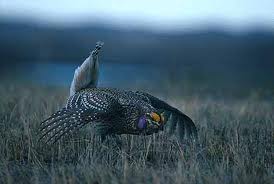
57 Western Meadowlark
- A group of Western Meadowlark are called a; Pod.
- We saw this bird on April 9th, and there is still 2 feet of snow on the level. Poor thing, someone didn't tell it spring hasn't arrived here yet. On the Canadian prairie and northern plains states they mark the arrival of spring with their pleasant flute like song.
- They are grassland birds. They are the state bird of 7 different prairie states. No wonder, they have one of the most beautiful flute like songs. My wife Vicki says it is her favorite of all song birds.
- They need deep old grassland for nesting and safety.
- The nest is made in deep grass with a grass woven roof on top. Most males have two females in their territory that they mate with. The female generally does most of the care.
- They eat bugs and grasshoppers. When not available they eat seeds and berries.
56 Canada Goose

- A Group of Canada Geese in the air is called a; Flock / Skein / Wedge / Team.
- A group of Canada Geese on land is called a; Gaggle.
- I often wonder how a Canada can walk out on ice and their feet don't freeze off or stick to the ice. Yikes! Well it turns out that a Canada has its blood veins and arteries running very close to each other in their legs. It is a very adaptive form of heat exchange. Yes the Canada is the first environmentalist and conservationist in Canada, it cools the blood going to its feet while warming the blood going back to its heart. Blood in a Canada is normally 104 F, blood in their feet is a cool 35 F. Because of this close proximity of veins and arteries the feet never get less than the 35 F and won't freeze. How cool is that.
- These birds are a very sought after game bird. I love Goose jerky and goose stew.
- They have adapted to live with man and are found in every major city and park and golf course. This can be a real problem for those people who don't like goose poo on their shoes or bare feet when walking on the shared grass. During the spring traffic signs can be found asking to yield to mothers and goslings where they are crossing the roads.
- Many Canada Geese don't migrate but the majority do. When they do you can find them flying in their traditional V shape to conserve energy by sharing the lead and air streaming. They can be herd encouraging the leader with their vocalization. In fact they have 13 different sounds learning these sounds even inside the egg. Now that is starting school at an early age.
- Their bill have lamellae or it is serrated to help cut vegetation. They are really good grazers, the Holstein cow of the sky.
- They are a beautiful bird with a gosling the color of the sun.


55 House Finch
- A group of House Finches are called a; Development.
- The original Angry Bird. This one is very unhappy it is April 7th, snowing and we still have 2 feet on the level. Last year I was golfing.
- Many people call this bird a pest. It harbors a multitude of chronic diseases at the bird feeder. This is bad news, I have over 100 Redpolls, 50 Sparrows, 10 Dark eyed Juncos, 8 Black Capped Chickadees, 6 Red Breasted Nuthatches, 4 White Breasted Nuthatches, 6 Downy Woodpeckers, 6 Hairy Woodpeckers, the occasional; Red Breasted Crossbill, Shrike, Blue Jay, Grey Jay.... You get what I'm saying, we don't need to spread any chronic sickness to the rest of this collective.
- These birds eat seeds and fruit.
- It was introduced to this part of the world back in the 1940's and done really well. They have replaced much of the native Purple Finch and House Sparrow. There is an estimated 1 billion of them. I may introduce this one to "Daisy".
- Yikes!
54 Loggerhead Shrike


- A group of Loggerhead Shrike are called an; Abattoir / Watch.
- This one crashed into our window chasing some poor little Red Polls.
- They generally eat grasshoppers and beetles when available, and mice and voles, and small birds when not.
- They kill their prey by breaking their necks and paralyzing them by cutting their throats with the aid of, wait for it, an anatomical or cutting tooth. YES I said a tooth. Who knew? Know wonder a group of these are called an Abattoir!
- They can carry prey up to their body weight in their feet and then impale them in thorns or a barb wire fence to eat. Their feet do not have talons to aid in the kill. Insects they will carry in their beaks.
- The eastern Loggerhead is endangered in Canada and in some states. The Prairie has seen signs of declining population as well. The Prairie Loggerhead is well liked by farmers for their fight on grasshoppers, beetles, mice and voles.
- They have 4-7 eggs about head height off the ground in April, both parents help raise them.

52 Snow Bunting

- A group of Snow Buntings are called a; Drift.
- This Drift seems to be fighting over some weed seeds.
- Snow Buntings have a winter plumage seen above with a tan coloration to it and a summer coat seen below, a beautiful black and white. (male). It only molts once a year in the fall. The tan coloration is warn off by the male rubbing in the snow before breeding season. (Wonder if rubbing in snow could get rid of some of my grey hair?)
- The male is very tentative to the female. He will leave for the north, where they breed, at the end of March well before other birds are returning and sets up a nest and defends its territory for 4-6 weeks until the female arrives. Temperatures can be -30 C. Yikes. Only one other bird is know to tolerate this cold the Raven and known to winter in coastal Alaska.
- Because they nest in the far north in rocky outcrops the female must stay with the nest to keep eggs warm. The male brings her food and cares for her. I like this guy even though we only get to see them on the prairie in the winter.

- Snow Buntings are also known as Snow Flakes.
51 Great Grey Owl
- A group of Great Grey Owls are called; Bazaar / Stooping / Parliament / Glaring / Wisdom.
- This Grey Owl we saw on our trip from Meadow Lake SK to Water Valley AB.
- This Owl has been known by many name; Phantom of the North / Spectral Owl / Lapland Owl / Spruce Owl / Bearded Owl / Sooty Owl.
- By length this is the biggest of all owls but by weight it falls way down leaving that distinction for the Great Horned Owl.
- They are extremely protective of their nest, known to drive away even Black Bears.
- Their size is mostly made up of fluffy feathers, they are very deceptive.

- Their large facial disks also known as "ruffs" help focus sound. They also have asymmetrical placement of ears, one lower than the other, helping to pinpoint prey. They can hear mice or moles under two feet of snow. They then "snow plunge" to get their prey, a type of hunting exclusive to this owl. They also have fixed eyes relying on the movement of the head 270 degrees to see or hear prey.
- They are semi-nocturnal, meaning they hunt mostly at night or near dark.
- The Great Grey Owl rely on old growth forest. In Canada we have a very well managed forestry industry keeping an effective balance of new, harvested and old growth. Other animals rely on new growth and harvested areas to survive.
- This moose we saw at Water Valley AB near my brothers. They are browsers and rely on harvested and new growth areas.
- Great Grey Owls are my favorite of the owls as you can see by the Stooping of pictures in my house.
- In March these birds nest. At 3 to 4 weeks the young jump out of the nest and then in another 1 to 2 weeks learn to fly. The Great Grey owl doesn't build a nest, the nest is in abandoned raptor nests. Yikes!